6 Proven Pre-Call Planning Steps to Win Sales Calls | PowerDialer.ai
Discover 6 proven pre-call planning steps to boost sales success. Prepare smarter, handle objections with confidence, and close more deals. Book a demo ...
I’ve been in sales long enough to know that the hardest part of the job isn’t just dialing numbers, it’s making those dials count. In the early days of my career, I’d pick up the phone, fire off a pitch, and hope for the best. Most of the time? Crickets. Voicemails, hang-ups, polite brush-offs, you name it.
It took me a while to realize that the real work doesn’t start on the call. It starts before the call.
The reps who take the time to prepare, even just a few minutes, are the ones who stand out. They don’t sound scripted, they don’t waste time, and they almost always get further in the sales process. That’s because pre-call planning isn’t a “nice-to-have”, it’s the difference between random dials and meaningful conversations.
Here are the six steps I’ve relied on (and taught my teams) to consistently turn calls into productive discussions and, ultimately, into deals.
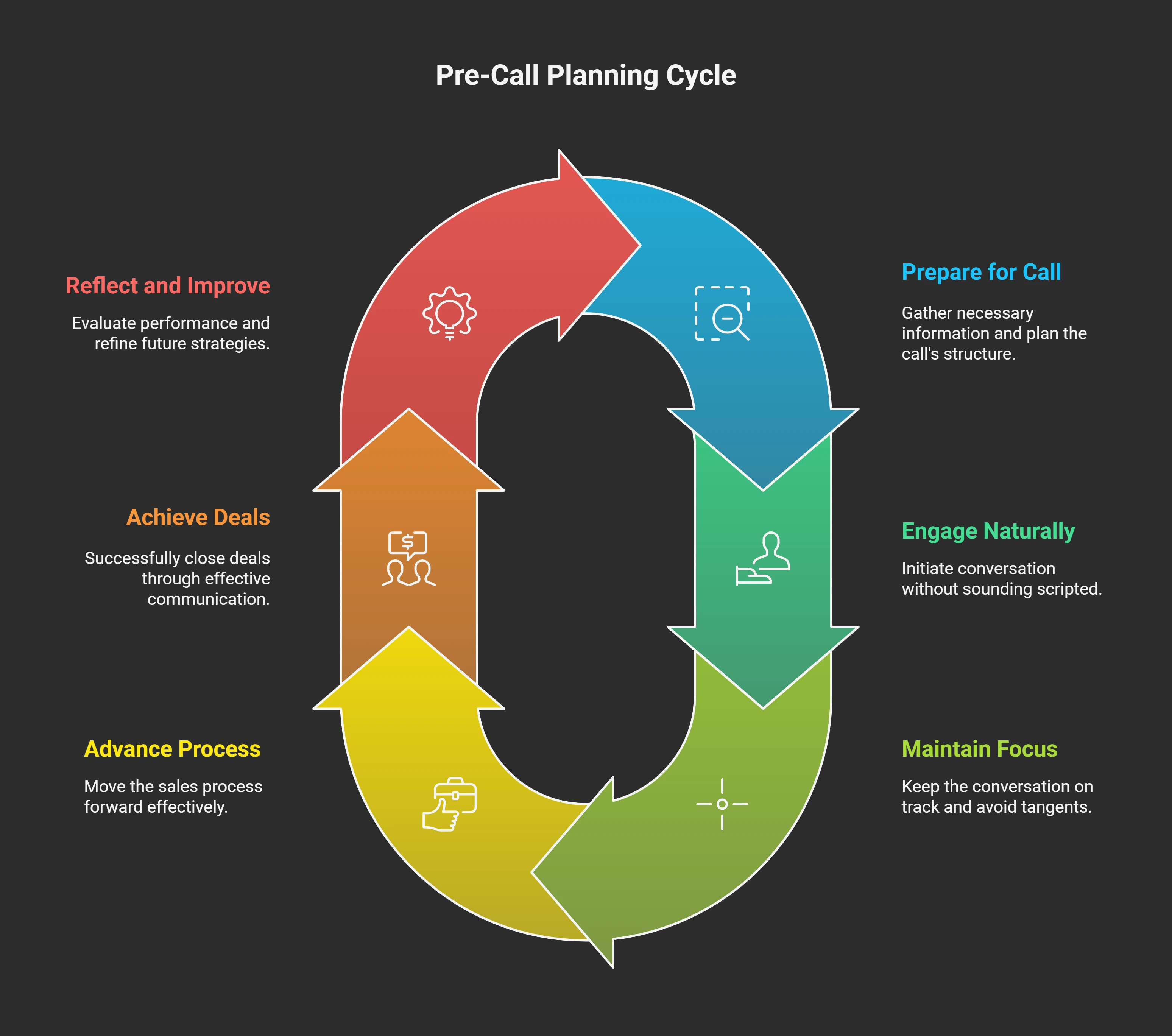
Step 1: Do Your Homework: Research the Prospect and Their Company
I’ll never forget one of my first cold calls. I jumped straight into a pitch without knowing who I was talking to. Turns out, I was speaking with someone who had zero influence on buying decisions, and worse, I pitched the wrong product line. The call ended before I’d even finished my intro. Lesson learned: research isn’t optional.
Before every call, I take a few minutes to:
- Look up the prospect on LinkedIn. What’s their role? How long have they been there? Do we have mutual connections?
- Check out the company: size, industry, product offerings, recent news. If they just raised funding or launched something new, mentioning it can be a great icebreaker.
- Stay aware of industry trends. If their competitors are making moves, or if the industry is facing a known challenge, it’s a talking point.
- Anticipate pain points. If I’m calling a sales leader, I already know time and efficiency are probably on their mind.
Tip: Create a quick research template in your CRM. That way, you’re not starting from scratch every time.
Step 2: Know What You Want: Set Clear Objectives
I used to wing it. I’d think, “Let’s just see where this goes.” Spoiler alert: it went nowhere. Calls without direction usually end in vague promises like “Send me an email” or “Let’s circle back.”
Now, I set clear objectives before every call. Sometimes my goal is to book a demo. Other times, it’s to uncover specific pain points or understand who’s involved in the buying process.
The key is to make those goals SMART, Specific, Measurable, Achievable, Relevant, and Time-bound. For example:
- Book a 30-minute demo within the next week.
- Identify their top two challenges with their current provider.
- Confirm budget and timeline for making a change.
When you know what you’re aiming for, it’s a lot easier to steer the conversation.
Step 3: Use a Script: But Keep It Flexible
I’ll be honest, I used to hate scripts. Reading from a piece of paper made me feel robotic, and it definitely sounded that way to prospects. But then I realized the problem wasn’t the script itself, it was how I was using it.
A good script isn’t about memorizing lines. It’s a safety net. It keeps you on track but leaves room to adapt. My “scripts” these days are more like bullet points. They include:
- An intro that feels personal. Mentioning their company’s recent announcement or congratulating them on a new role shows you’ve done your homework.
- A short value statement. Something like, “I help sales teams save hours a week by cutting wasted dials.”
- Open-ended discovery questions. For example: “How are you currently handling call volume with your team?”
- Prepared responses to objections. More on that next.
Tip: Say it out loud before your call. If something feels stiff, rewrite it in your own words. The goal is to sound natural, not rehearsed.
Step 4: Expect Objections, and Plan for Them
If you’ve made even five cold calls, you’ve heard objections. “We already have a provider.” “Now’s not a good time.” “Can you just send me an email?”
I used to panic when I heard those. Now I see them as opportunities. An objection means they’re at least engaging with me.
Here’s my go-to framework:
- Listen. Don’t cut them off. Let them finish.
- Acknowledgement. “I get it, a lot of companies feel the same way at first.”
- Redirect with value. “What they found, though, was that by trying our solution, they were able to cut costs without changing their workflow.”
Over time, I built a personal “cheat sheet” of the top five objections I heard and my best responses. Practicing those made me sound more confident and less defensive.
Step 5: Talk to the Right People
This one seems obvious, but you’d be surprised how many reps spend weeks talking to people who can’t say yes. I’ve done it myself, built great rapport, had great conversations, only to find out the person was an influencer, not a decision-maker.
Here’s what works for me:
- On LinkedIn, scan for VPs, Directors, or “Head of” titles.
- Ask directly: “Who else is usually part of this decision?”
- Use gatekeepers wisely. If you treat them with respect, they’ll often point you to the right person.
It’s not about being pushy, it’s about being efficient. Decision-makers appreciate when you cut through the noise.
Step 6: Get Your Head in the Right Place
Even with all the prep in the world, your mindset can make or break the call. If you sound tired, rushed, or uncertain, prospects pick up on it immediately.
Before I dial, I do a quick reset:
- Skim my notes and objectives.
- Take a deep breath or stand up and stretch.
- Remind myself: “I’m not just selling something. I’m solving a problem.”
It sounds simple, but that mental shift changes your tone. And yes, smiling while talking actually works, people can hear it in your voice.
Mistakes I See Reps Make All the Time
- Jumping on a call without research → irrelevant conversations.
- Winging it without objectives → wasted time.
- Reading a script word-for-word → robotic tone.
- Talking to the wrong contact → stalled deals.
- Dialing with low energy → weak first impressions.
Real-Life Contrast
At one company, I worked with two reps who had completely different styles.
- Rep A: Made over 100 calls a day with zero prep. Tons of activity, almost no results.
- Rep B: Made fewer calls but followed these six steps religiously. Booked twice as many meetings.
The difference wasn’t effort, it was preparation.
Tools That Help
You don’t have to do this alone. A few tools can make pre-call planning a lot easier:
- LinkedIn → Prospect and company research.
- CRM notes → Track past conversations and objectives.
- PowerDialer.ai → Automates dialing, organizes your call notes, and keeps everything in one place so you can focus on the conversation, not the admin.
Wrapping It Up
Pre-call planning doesn’t have to take forever. Even 10 minutes of smart preparation can completely change the outcome of a call. By researching prospects, setting clear goals, using a flexible script, preparing for objections, reaching decision-makers, and getting in the right mindset, you put yourself miles ahead of the average rep.
At the end of the day, it’s not about making more calls, it’s about making better calls.
If you want to make those calls even more effective, check out PowerDialer.ai. It helps you plan, dial, and follow up with ease, so you can spend more time having real conversations and less time chasing voicemails.
FAQs
Q1. What is pre-call planning? It’s the prep work you do before dialing to make your conversations more focused and productive.
Q2. How long should it take? Anywhere from 5–15 minutes, depending on the complexity of the account.
Q3. Do I really need a script? Yes, but think of it as a guide, not a script to read word-for-word.
Q4. Why does it matter to reach decision-makers? Because they’re the ones who can actually approve or buy your solution.
Q5. Can pre-call planning really boost results? Absolutely. It helps you build trust, handle objections smoothly, and move deals forward faster.
Q6. How do I keep my confidence up on calls? Preparation, practice, and the mindset that you’re helping, not just selling.
Q7. Which tools can help? LinkedIn, CRM systems, and PowerDialer.ai are some of the best for organizing and streamlining your pre-call prep.
Q8. What’s the best way to handle objections? Listen fully, acknowledge their concern, and show how your solution provides value despite it.
Try it on your own list
Per-seat pricing, published, with no seat minimum. See the pricing.