Cold vs Warm Calling: Differences to Boost Sales | PowerDialer.ai
Learn the key differences between cold vs warm calling, improve lead conversion, and boost sales. Book your demo with PowerDialer.ai today.
Being proficient at cold and warm calling is crucial today in this competitive B2B selling environment in a bid to enable businesses to drive maximum revenues, close additional leads, and optimize their sales pipeline. Every sales organization grapples with reaching the correct targets, winning them over, and advancing them in the sales pipeline at a fast pace. Comprehending cold and warm call variations can have a great impact on the sales outreach strategies and provide better return on investment on every sales attempt.
Whether your goal is to generate new leads, nurture existing relationships, or improve overall sales effectiveness, knowing when to use cold or warm calling is essential. In this article, we’ll break down their definitions, characteristics, advantages, challenges, best practices, and practical tips to help your team succeed.
Why Understanding Cold vs Warm Calling Matters
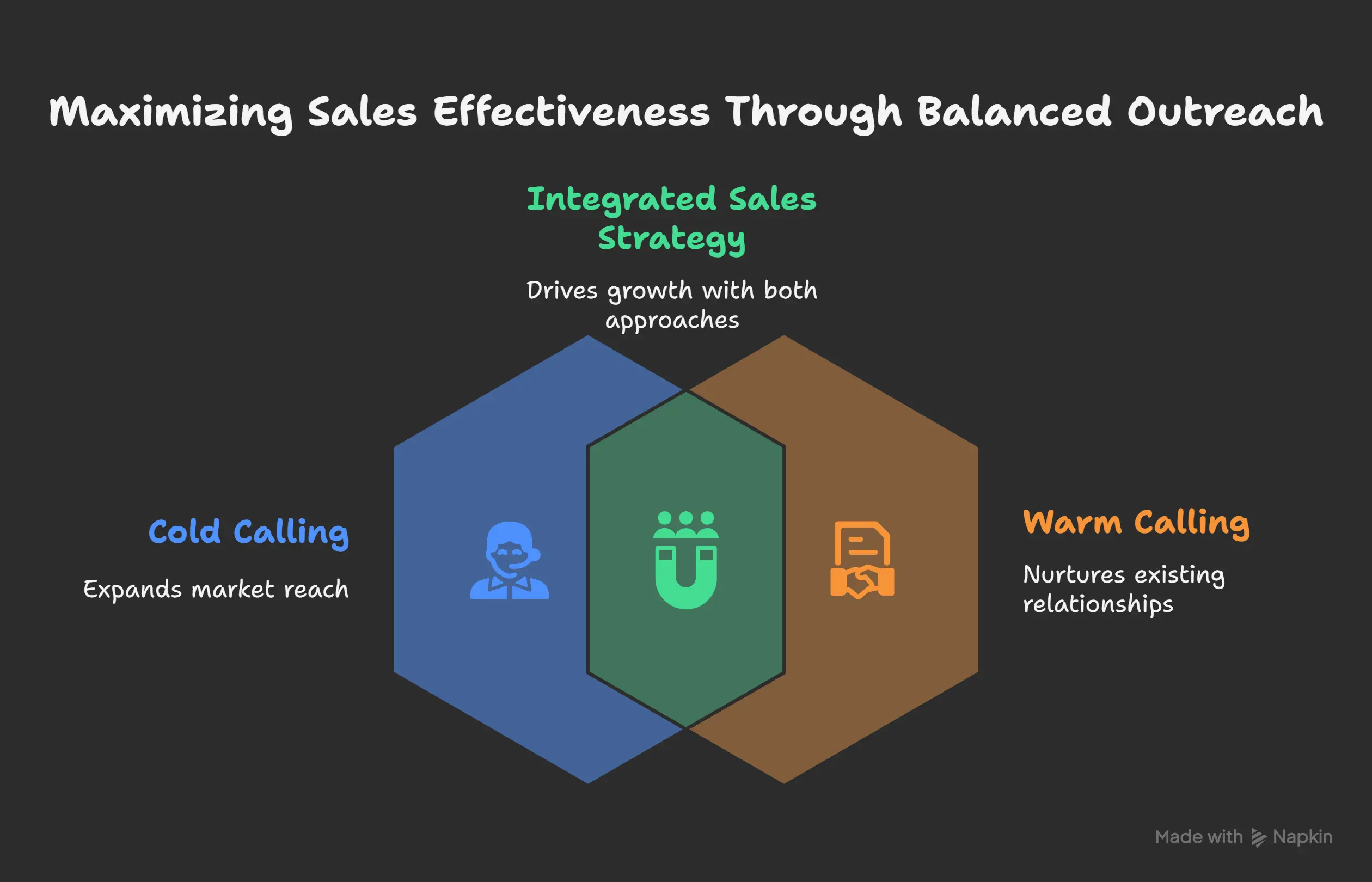
Telesales remains a direct customer contact and lead generation staple. Not all calls, however, are made equal. Cold calls address prospects with whom there has been no contact at all, while warm calls are made among prospects who have had some level of interest in the product or service in the past. The recognition of differences allows sales teams to better plan resources, customize messaging, and ultimately foster leads.
Through knowing cold vs warm calling, companies can organize their sales and marketing departments in a way that the outreach campaign is maximized. Having the correct technique at the correct selling stage ensures that the leads are properly nurtured, prospects are approached with the correct strategy, and the opportunities are not lost due to ineffective sales efforts.
What is Cold Calling?
Cold calling refers to the process of dialing possible customers without any previous contact with your business. The main goal is to create new leads, promote brand awareness, and fill the sales pipeline. Cold calling can be effective in untapped markets where businesses want to reach farther.
This method is a fundamental component of any lead generation strategy and most often is the first point of contact in the selling process. Cold calling, executed effectively, will be able to identify top-quality potential customers and lay the groundwork for more substantial engagement.
Key Cold Calling Characteristics
- Low Pre-Engagement: The potential customers wouldn’t know that your business exists.
- High Rates of Rejection: Cold calls are likely to face initial resistance and have to be insistent.
- Scripted Method: Calls are typically scripted to provide sufficient value.
- Volume-Based: It is based on running across a large number of potential prospects.
- Data-Driven: Depending on good lists of prospects and good targeting practices.
Strengths and Weaknesses of Cold Calling
Strengths:
- Increases coverage to new markets and prospects.
- Generates new sales leads for salespeople.
- Generates brand presence in low-penetration markets.
Weaknesses:
- High levels of rejection have a depressive effect on morale.
- Tedious without automation.
- It requires highly trained sales forces to handle objections professionally.
Cold calling can, nonetheless, be highly productive with the support of technology that enables more advanced prospect research, dialing sequence automation of calls, and tracking of engagement metrics. PowerDialer.ai is one of the software programs that helps sales organizations attain better efficiency while enabling personalization.
What is Warm Calling?
Warm calling is calling prospects who have previously been contacted by your company. These can be leads received from a web query, referral, content download, or previous call. Warm calling is meant to nurture these leads, build trust, and nudge them toward a purchasing decision.
Warm calling utilizes the past history of the prospect to personalize and make contacts more engaging. It forms the foundation for customer interaction expansion and increased conversion rates through the sales pipeline.
Key Features of Warm Calling
- Pre-Qualified Leads: The leads are already interested in your business or service.
- Higher Rate of Engagement: Warm leads enjoy a higher rate of engagement.
- Interactive Touch: Calls are placed based on past engagements.
- Relationship-Based: Success is dependent on relationship development and maintenance.
- Smaller Prospect Pool: Warm leads are in short supply, and they will require ongoing nurturing strategies.
Strengths and Weaknesses of Warm Calling
Strengths:
- Increased conversion rates due to prior interaction.
- Easier to build rapport and create trust with prospects.
- Successful use of selling assets, since efforts are focused on high-value prospects.
Weaknesses:
- Fewer leads to draw upon compared to cold calling.
- Heavily dependent on top-notch lead generation by the marketing department.
- Requires ongoing follow-up to keep prospects interested.
Differences between Cold vs Warm Calling
Approach and Tone
- Cold Calling: More formal, usually script-based approach to generating interest in the shortest time possible.
- Warm Calling: Less formal and more relationship-focused, emphasizing relationship building.
Response and Conversion Rates
- Cold Calls: Generally have lower response and conversion rates.
- Warm Calls: Higher engagement and conversion due to brand familiarity.
Effort and Resources Required
- Cold calling requires high volume and persistence.
- Warm calling focuses on quality, preparation, and follow-up on time.
Best Practices for Cold Calling
- Research Prospects in Depth: Familiarize yourself with the prospect’s industry, job title, and pain points.
- Personalize the Introduction: Even on cold calls, references to relevant information increase interest.
- Highlight Value Early: Clearly explain the value to capture attention.
- Scripts with Flexibility: Have structured scripts but leave room for conversation.
- Monitor and Analyze Results: Leverage CRM tools and analysis to streamline outreach efforts.
Best Practices for Warm Calling
- Refer Back to Past Interactions: Leverage facts that were collected from earlier interactions to build a tailored conversation.
- Meet Specific Needs: Customized solutions to meet the prospect’s defined needs.
- Follow Up Quickly: Act on leads while interest is fresh.
- Leverage CRM Insights: Leverage lead history, interaction behavior, and preferences.
- Emphasize Relationship Building: Warm calling is more about relationship building than selling.
Tools and Technology for Successful Calling
Sales teams today rely on technology to leverage cold and warm calls:
- CRM Systems: Keep customer data and track interactions.
- AI-Dialers: AI-powered call cadences and productivity optimization are enabled through tools like PowerDialer.ai.
- Call Analytics: Measure call performance, conversion rates, and engagement scores.
- Automation: Follow-ups are automated, messaging is customized, and campaign performance is monitored.
All these functions reduce drudgery, increase augmented sales effectiveness, and allow teams to spend time on high-value discussions rather than repetitive ones.
Actionable Tips to Succeed at Cold and Warm Calling
- Segment Leads: Segment prospective prospects for cold and warm calling.
- Combine Strategies: Use cold calls to fill your pipeline and warm calls to close leads.
- Train Teams Constantly: Continuous skill-building results in maximum objection handling and messaging.
- Measure KPIs: Track response rate, conversion rate, and average call time metrics.
- Combine Multichannel Outreach: Mix calls with emails, LinkedIn outreach, and marketing campaigns for higher effectiveness.
Conclusion
Both warm and cold calling play a key role in an effective sales strategy. Cold calling enables businesses to generate new leads and expand market penetration, while warm calling builds relationships and fuels conversions. Using a combination of these approaches, coupled with data analytics and advanced tools, is the key to a solid sales pipeline, improved lead conversion, and revenue growth.
Companies that use technology tools like PowerDialer.ai can automate calls, follow up on leads effectively, and every conversation can add considerably to business outcomes.
Ready to transform your sales outreach and boost conversion rates?
Try PowerDialer.ai to automate calls, follow up on leads, and optimize sales effectiveness. Book your demo today.
FAQs
Q1. Cold calling or warm calling: which one is best?
They are both valuable. Cold calling generates new leads, whereas warm calling converts and follows up high-priority leads.
Q2. How do I increase cold calling success?
Personalize scripts, conduct research on targeting, and utilize automation tools like PowerDialer.ai to achieve maximum efficiency.
Q3. Why is warm calling better?
Pre-screened leads and prior interactions enhance engagement, credibility, and conversion rates.
Q4. Can technology be helpful for cold and warm calling?
Yes. Marriage of CRM with AI dialing and analytics software streamlines processes and provides the highest returns.
Q5. Business institutions must use cold vs warm calling how often?
An ideal mix balance is ideal: cold calling to bring in leads, warm calling to close them out as customers.
Try it on your own list
Per-seat pricing, published, with no seat minimum. See the pricing.