How Revenue Orchestration Outperforms CRM & RevOps | PowerDialer.ai
Learn how Revenue Orchestration outperforms CRM & RevOps for scalable growth. Book a demo with PowerDialer.ai today!
Revenue Orchestration is no longer a buzzword; it’s the magic formula by which businesses are driving profitability and scaling with ease these days. Traditional CRMs just store data, while Revenue Orchestration follows marketing, sales, and customer success touchpoints, automates repeated tasks, and delivers smart insights that inform every decision.
Companies have depended on CRMs and then RevOps structures across the decades. Oh, sure, those systems did standardize data and streamline data by the team, but even they were not end-to-end connected in their architecture, and the cracks began that didn’t enable scaling. Today, with competition more fierce and customer expectations higher, companies require a solution that breaks down data silos, optimizes sales performance, and powers repeatable sales operations, and that is Revenue Orchestration.
Speaking to why Revenue Orchestration beats CRM and RevOps, and how leveraging technology such as PowerDialer.ai makes this transition so smooth and powerful.
Unlocking the full potential of Revenue Orchestration
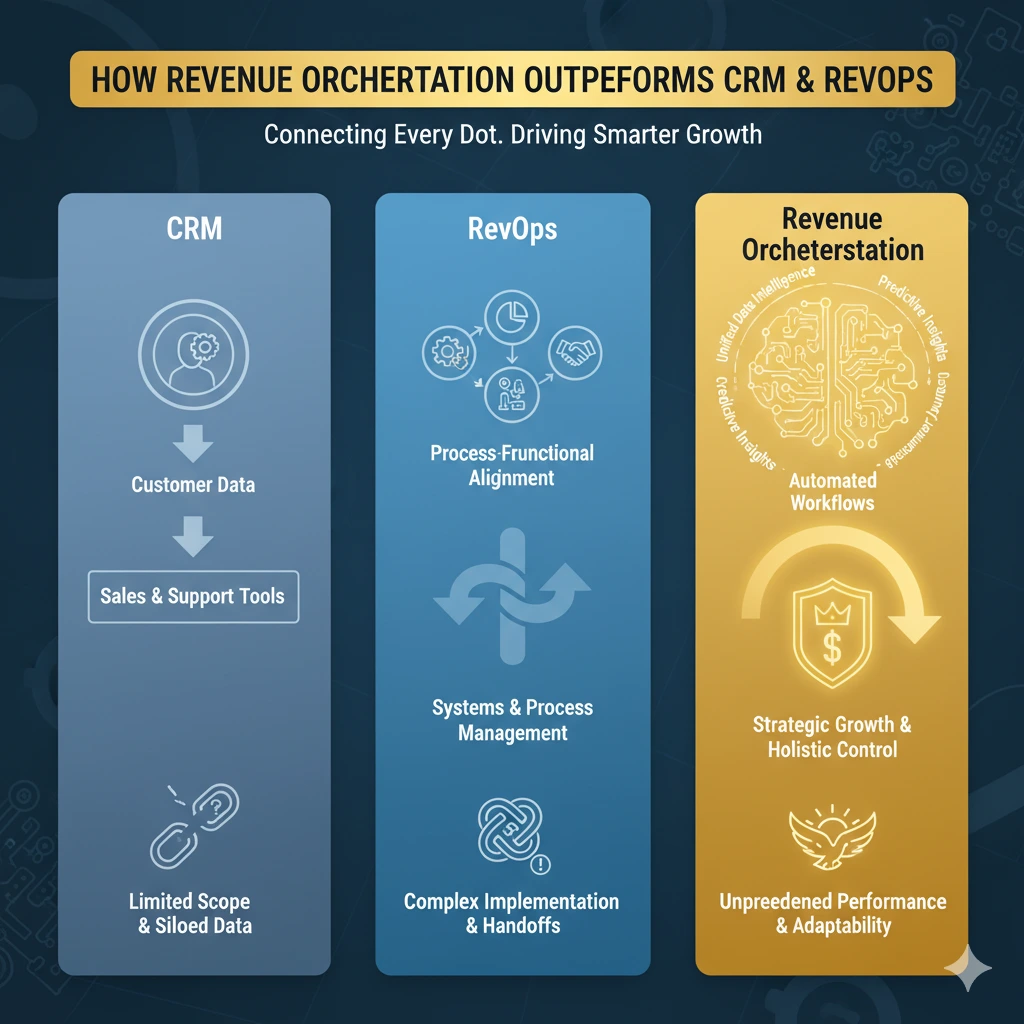
Over the past ten years, how businesses make revenue growth and sales happen has transformed. People want relevant, real-time experiences, and businesses have to move faster than ever to stay ahead. CRMs and RevOps were intermediaries in that evolution, but today’s teams require something more intelligent and integrated.
What Traditional CRMs Were Designed to Do
Imagine CRMs as steroid-infused web Rolodexes. They hold customer information, monitor interactions, and automate certain processes. A CRM might remind a salesperson of the last time a lead engaged with your business, or inform a marketing department which campaigns were well-received.
CRMs aren’t holy grails, however:
- Data silos: CRMs are in data silos, breaking marketing, sales, and customer success teams apart.
- Manual effort: Activities such as logging calls, sending follow-up emails, and managing opportunities put selling time out of your control.
- Limited insight: CRMs are data repositories, do not make interpretations of data or offer predictive recommendations for wiser decisions.
In short, CRMs are great at looking neat but awful at managing.
The Role of RevOps in Modern Sales
Revenue Operations (RevOps) was created to bridge customer success, marketing, and sales’ alignment gaps. Its mission is to put teams in agreement, establish definite metrics, and improve operational efficacy through the utilization of the revenue cycle.
RevOps accomplishes this by:
- Centralizing data: Gathering data from different systems.
- Aligning teams: Training departments to align in the direction of common revenue objectives.
- Streamlining processes: Facilitating the elimination of redundant work and streamlined processes.
But still, issues exist:
- Not enough automation: There remains too much to be handled manually.
- Background overview: RevOps alerts teams to what happened, though perhaps not why or how to respond properly.
- Late adoption: Teams require more timely data on which to act on changes in the market.
Why CRM and RevOps Fall Short Today
CRM implemented through RevOps makes them better, but still with critical gaps. Today’s business requires:
- Automating sales to deal with routine tasks.
- Revenue intelligence that can generate actionable insights.
- End-to-end orchestration of customer success, marketing, and sales.
Each of these silos is connected by Revenue Orchestration, providing organizations with one smart system for maximizing all revenue touchpoints.
What Is Revenue Orchestration?
Definition and Core Concept
Revenue Orchestration is the alignment, automation, and optimization of every process that drives revenue within a business. It is powered by CRM, marketing automation, and customer success data to deliver actionable and real-time insights.
Revenue Orchestration is not task management. It’s execution, with each team working at maximum efficiency towards the same revenue objectives.
How It’s Different from CRM and RevOps
CRMs and RevOps are awesome, but Revenue Orchestration is revolutionary because it:
- Bridges teams’ data: Eliminates data silos through a single source of truth.
- Streamlines workflow: Automates routine work, enabling teams to concentrate on high-value work.
- Gives predictive insight: Uses AI to predict revenue behavior and inform decision-making.
- Supports scalable growth: Expands with businesses without added complexity.
Key Building Blocks of a Revenue Orchestration Platform
Unified Data Layer
All go-to-market teams work from the same correct information, eliminating errors and enhancing collaboration.
Automated Workflows
Automated follow-up, lead scoring, and task assignment are performed, optimizing pipeline effectiveness.
AI-Driven Insights
Predictive analytics divides the customer journey into two, delivering actionable insights that inform smarter decisions and smarter sales performance.
Cross-Team Harmony
Marketing, sales, and customer success play from the same playbook with a single message and one customer experience.
5 Ways Revenue Orchestration Exceeds CRM and RevOps
1. Increased Revenue Visibility
Revenue Orchestration consolidates all GTM data into a single, holistic dashboard. Teams see pipelines, forecasts, and performance in real time. End-to-end visibility allows leaders to:
- Identify bottlenecks before they affect revenue.
- Tune strategies based on revenue operations trends.
- Enhance engagement accuracy with predictive insights.
Compared to CRMs, where manually running reports is required, Revenue Orchestration ensures some teams receive the right data at the right time.
2. Execution-Driving Automation
Reps invest hours of their week in non-value-added tasks, logging calls, emailing, and opp updating. Revenue Orchestration platforms automate them so that each touch point is done with ease.
Advantages are:
- Enhanced rep productivity.
- Follow up on leads at increased velocities.
- Improved customer lifecycle management.
Automation enables organizations to scale without adding headcount or complexity.
3. Data Intelligence, Not Data Storage
Revenue Orchestration platforms deliver actionable data in the form of revenue intelligence. That is:
- Prioritization of high-probability-to-convert leads.
- Prescription of best-practice outreach programs.
- Predictive forecasting of revenue trends.
Unlike standard CRMs that merely store information, Revenue Orchestration truly drives decisions.
4. Seamless Cross-Department Synchronization
Perhaps the biggest obstacle to revenue operations is teams aligning. Marketing, sales, and customer success operate in isolation, producing inefficiencies and inconsistent customer experiences.
Revenue Orchestration:
- Provides each team with a single source of truth.
- Provides messaging and strategy alignment throughout the customer journey from lead to renewal.
- Drives increased conversion rates and customer satisfaction.
This type of GTM alignment can’t be achieved with CRM or RevOps in isolation.
5. Scalability Without Complexity
- Processes always fall behind as businesses grow.
- With Revenue Orchestration, businesses scale in beauty.
- Automatically, processes scale as teams expand.
- AI suggestions stay ahead of the sales tech stack.
- Pipeline management and forecasting stay precise despite increased data.
How PowerDialer.ai Enables Real Revenue Orchestration
To realize the full potential of Revenue Orchestration, businesses require a platform that integrates data, automates, and gives actionable insights. That is precisely what PowerDialer.ai does.
AI-Powered Outreach and Smart Workflows
PowerDialer.ai uses AI to drive outreach at scale, allowing leads to be dialed at the right time and ranked by sales performance. Reps spend more time selling and less time executing repetitive tasks.
Real-Time Data Synchronization and Auto-Dialing
The solution synchronizes CRM and RevOps tool data. Auto dialing eliminates human error possibilities and maximizes efficiency for faster deal closure.
Seamless CRM and RevOps Tool Integration
PowerDialer.ai fills system gaps, providing a single layer of truth. Customer success, sales, and marketing teams have a single source of truth with which to work, and pipeline efficiency and execution become simpler.
Example Use Case:
Sales teams operating with PowerDialer.ai can:
- Connect leads in a shorter time.
- Automation of follow-up.
- Channel performance measurement.
Outcome: end-to-end orchestrated revenue process, enhancing forecast accuracy and scalable sales operations.
ROI of Transitioning from CRM to Revenue Orchestration
Improved Lead Conversion
Streamlining processes and delivering AI-driven insights, Revenue Orchestration ensures leads are properly nurtured, hence the conversion rate is enhanced.
Accelerated Sales Cycles
Alignment of functions and streamlined processes accelerates decision-making; hence, deal closure is accelerated.
Enhanced Forecasting Accuracy
Predictive analytics acts as a true image of pipeline health, enabling accurate revenue planning.
Sustained Revenue Growth
Revenue Orchestration combines automation, revenue operations, and intelligence to power repeatable, sustained growth without increasing headcount or complexity.
Conclusion: The Future is Revenue Orchestration
CRM preceded it. RevOps was the middle ground. But Revenue Orchestration is where it’s headed today, an architecture that brings all GTM motions together, automates coordination, and scales growth smartly.
If your CRM is a graveyard of data and your RevOps is still spreadsheet-driven, it’s time to grow up. Schedule a free demo with PowerDialer.ai and discover how AI-driven orchestration turns into real, scalable revenue growth.
FAQs
Q1. What is the biggest difference between CRM and Revenue Orchestration?
CRM contains customer information; Revenue Orchestration connects, automates, and optimizes every revenue touchpoint in marketing, sales, and customer success.
Q2. Does Revenue Orchestration supplant RevOps and CRM?
No, it’s an augmentation of them. It’s the orchestration layer that aligns data, workflows, and automation across and between the revenue engine.
Q3. How does Revenue Orchestration enable sales teams to scale more quickly?
With automation, real-time insights unlocked and action aligned across departments, reps get to sell, not do administrative tasks.
Q4. Are small teams able to use Revenue Orchestration products such as PowerDialer.ai?
Absolutely. PowerDialer.ai’s orchestration engine is built to scale, ideal for startups and enterprise GTM teams alike.
Q5. What kind of ROI can businesses expect?
Orchestration teams generally experience a 20–40% increase in deal velocity along with improved rep productivity through automation as well as consistent visibility.
Try it on your own list
Per-seat pricing, published, with no seat minimum. See the pricing.