What Is Account-Based Marketing? 8 Steps B2B Teams Need | PowerDialer.ai
Learn what Account-Based Marketing is, its benefits, and 8 steps to start ABM. Boost ROI with proven strategies. Book a demo with us today!
Account-based marketing (ABM) has rapidly emerged as one of the most successful B2B marketing tactics for businesses seeking to grow more intelligently, not merely larger. Previously, marketers concentrated on creating broad funnels, gathering thousands of leads, qualifying them, and praying for some conversion. Although effective in consumer markets, this tactic usually squanders money and time in B2B, where transactions are high-value and require multiple decision-makers.
With ABM, the strategy is inverted. Rather than throwing a broad net, companies focus on target accounts that are the best fit for their ideal customer profile. These are businesses with the highest potential to earn high revenue and long-term relationships.
The difference between lead generation and ABM comes down to quality versus quantity. Traditional lead generation is about volume: gather as many leads as possible, then filter them. ABM is about precision: identify high-value accounts from the start and engage them with personalized campaigns.
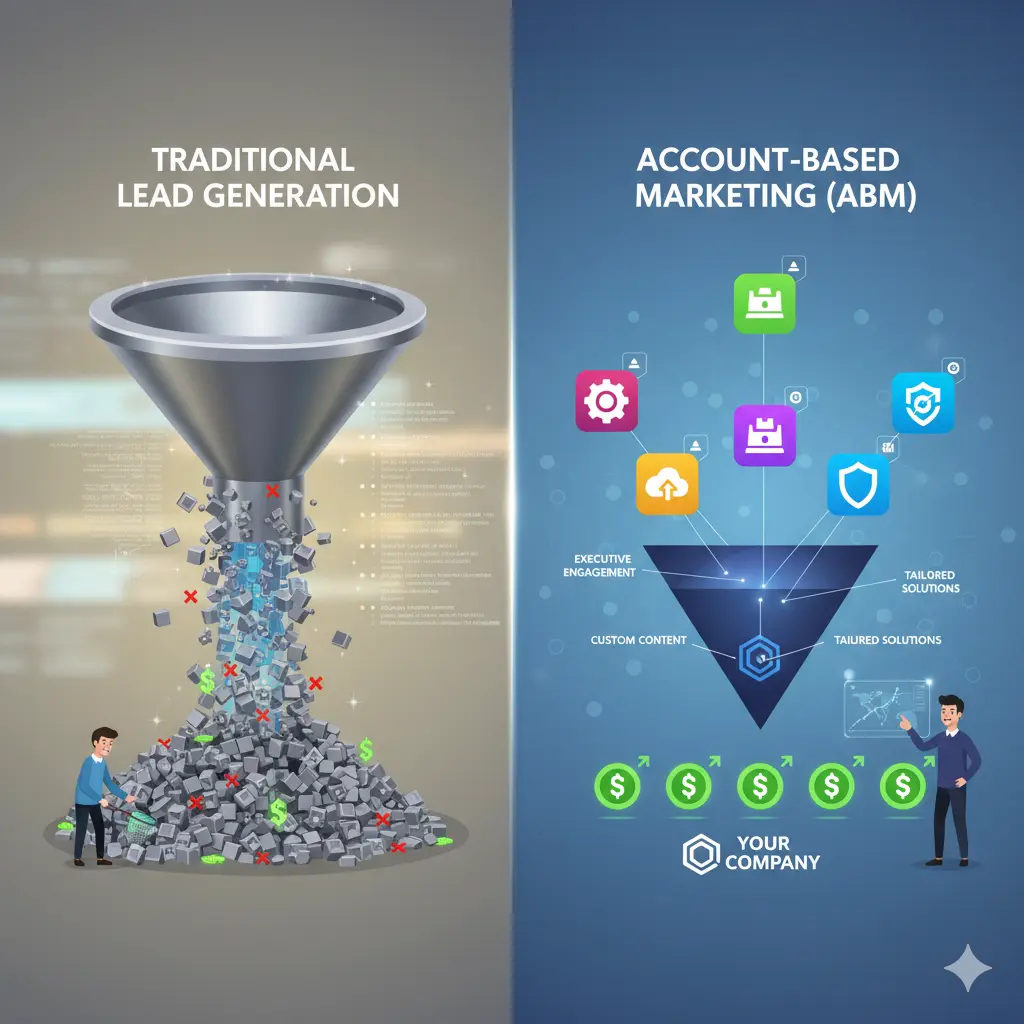
So why is ABM the go-to B2B marketing strategy today?
- Efficiency: No wasted effort on low-value leads.
- Stronger relationships: Teams engage directly with key decision makers.
- Revenue growth: Faster closing of larger deals by concentrating on accounts that really count.
In brief, ABM is transforming the way B2B companies obtain growth in competitive markets.
What Is Account-Based Marketing (ABM)?
Account-Based Marketing (ABM) is a very targeted B2B marketing approach that values quality over quantity. Rather than creating a big list of random leads, ABM starts by finding high-value accounts that most closely resemble your ideal customer profile. Every account is handled like a market unto itself, with bespoke campaigns that are intended to appeal to decision-makers and respond to the particular challenges of each. This strategy enables marketing and sales teams to operate harmoniously, engaging the ideal accounts with the right message at the right moment. By eliminating the scatter gun approach, ABM enables organizations to establish deeper relationships, speed up deal cycles, and experience greater ROI. It’s not a matter of chasing everybody, it’s a matter of acquiring the accounts that are most important.
The Core Idea: Targeting Accounts, Not Leads
ABM addresses every firm as its own market. Rather than pursuing anonymous clicks or isolated leads, your marketing and sales teams work together to comprehend the layout, decision-making model, and agony of targeted accounts.
For instance:
- A cloud security software-as-a-service firm might pursue Fortune 500 companies and craft campaigns based on cloud security issues that concern CTOs.
- A consulting company might extend invitations to CFOs of targeted accounts to exclusive roundtable meetings specific to their sectors.
- By doing so, campaigns are more likely to resonate with the individuals who truly have decision-making authority.
Advantages of Account-Based Marketing
- Increased ROI: Each dollar is invested in accounts that are most likely to convert.
- More cohesive relationships: Trust increases when businesses realize campaigns address them specifically.
- Faster deal cycles. Sales teams concentrate on active accounts rather than pursuing unqualified leads.
- Revenue growth: Businesses following ABM always show bigger deal sizes and improved lifetime value.
When you go with ABM, you’re not launching another campaign; you’re establishing a long-term architecture for repeatable revenue expansion.
8 Steps to Build a Successful ABM Strategy
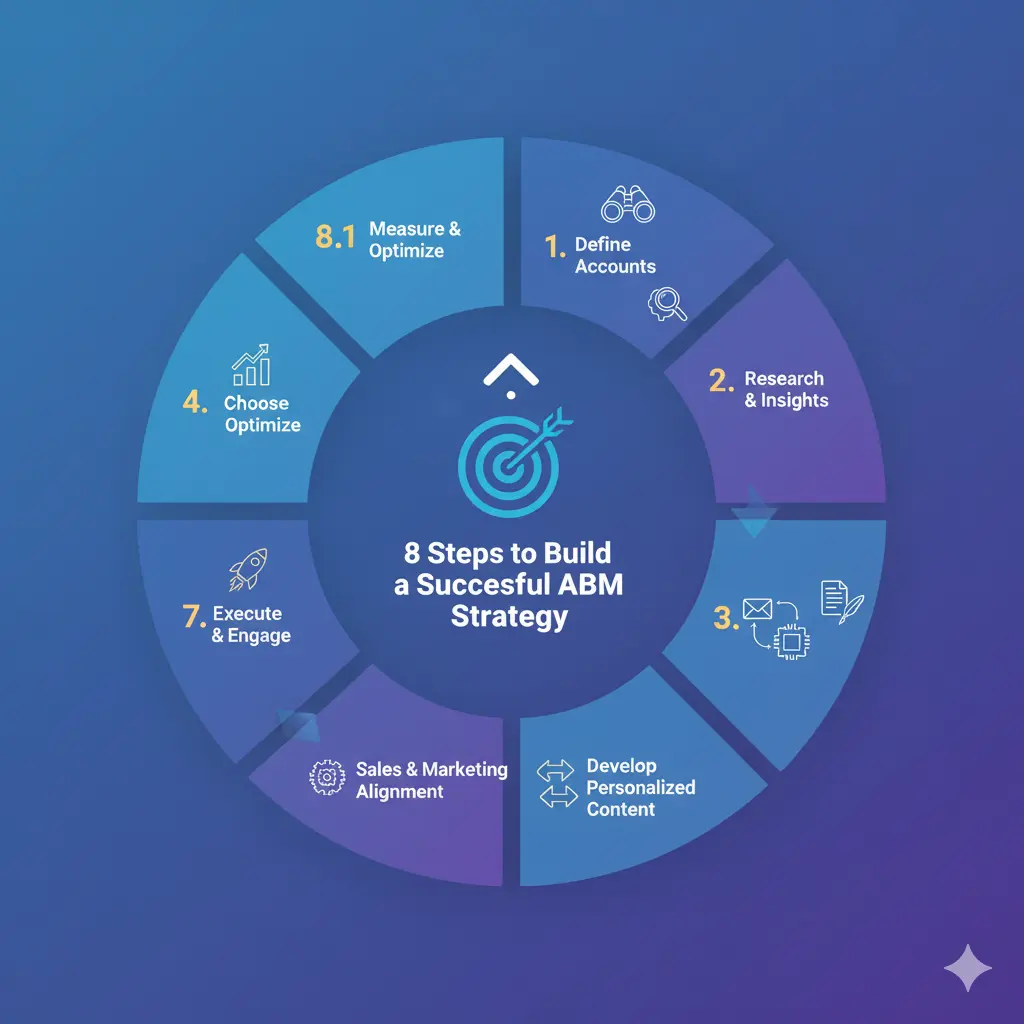
Step 1: Identify High-Value Target Accounts
The initial step in every ABM approach is choosing the proper accounts. All prospects are not equal. You need to work only with the most promising businesses that can give you revenue growth and a long-term business association.
Here’s how:
- Firmographics: Review company size, revenue, industry, and geography.
- Technographics: Check what tools, platforms, and systems they are already using.
- Intent data: Track purchasing intent, e.g., content downloads, attendance at events, or searches for your solution.
Example: A cloud cybersecurity SaaS might recognize banks that are actively investigating “cloud compliance” and already on AWS.
By targeting accounts where you can provide the greatest value, you maximize efficiency and enhance outcomes from day one.
Step 2: Align Sales and Marketing Teams
Sales and marketing alignment is the foundation of ABM. In contrast to inbound marketing, wherein leads are passed down toward the end of the funnel, ABM demands constant cooperation from beginning to end.
Alignment entails both organizations concurring:
- Which accounts to pursue
- What messaging will resonate with those accounts
- How success will be measured
For example, marketing might develop a bespoke report to cater to CIO issues, and sales utilizes such a report for one-to-one outreach. This collaboration guarantees that there is cohesion in all touchpoints.
When sales and marketing align, businesses achieve quicker deal cycles and increased conversion rates because everyone has the same revenue objective in mind.
Step 3: Define Clear Goals and Metrics
An ABM program without goals is like a ship without a compass. Before launching campaigns, define what success looks like.
Common ABM KPIs include:
- Engagement with key decision makers: meetings booked, emails opened, and webinar attendance.
- Pipeline velocity: how quickly deals move through stages.
- Revenue contribution percentage of total revenue attributed to ABM campaigns.
Example: Rather than having a general objective of “boost engagement,” create a quantifiable goal like “receive 25% engagement from target accounts in 90 days.”
By establishing realistic, measurable metrics, your team remains on track and can refine as campaigns progress.
Step 4: Build Account Personas and Buyer Journeys
Every target account has several stakeholders, decision makers, influencers, and end users. A CEO will think of business expansion, whereas a CTO thinks about scalability and security.
That’s why account personas need to be built. Chart out:
- Who are the major decision makers
- Their pain points and challenges
- Their goals and buying triggers
- Preferred communication channels
Example: If going after a manufacturing firm, the COO will require efficiency information, whereas the CFO desires ROI forecasts.
By mapping out the buyer journey for each persona, you can craft campaigns that speak to their very issues, making every touchpoint highly personalized.
Step 5: Develop Personalized Content & Messaging
Personalization is the core of ABM. Canned campaigns will not work. Every account should be made to feel like your campaign was customized just for them.
Examples of personalized campaigns include:
- Email sequences custom messages that cite industry-specific pain points.
- LinkedIn ads: advertising to executives at select accounts using targeted content.
- Direct mail: mailing physical packages or books to high-value accounts.
- Exclusive events/webinars: created exclusively for select companies.
Example: Instead of a generic webinar on “Cloud Security,” offer a private session for CIOs at your target accounts, highlighting compliance issues specific to their industries.
Personalized content creates deeper relationships and significantly boosts customer engagement.
Step 6: Select the Proper ABM Tech Stack
Technology enables ABM to scale and be measurable
Your ABM stack should have:
- CRM solutions (HubSpot, Salesforce) to take care of accounts.
- ABM platforms such as Terminus, Demandbase, or 6sense for campaign management.
- Sales engagement platforms to send consistent follow-ups.
These enable continuous tracking of every touch, optimizing content performance, and measuring outcomes at both the account and campaign level.
Tip: For calling sales teams reaching decision makers, solutions like PowerDialer.ai seamlessly integrate to enable reps to reach more accounts quicker with less manual work. Schedule a demo today and see how it’s done.
Step 7 – Roll Out and Run Targeted Campaigns
Once the foundation is set, it’s time to launch your Account-Based Marketing campaigns. Execution is where the real magic happens. Unlike traditional marketing, ABM requires multi-channel, multi-touch campaigns to make sure your target accounts consistently see and engage with your message.
A sample campaign could be as follows:
- Warm up accounts with LinkedIn ads to decision makers.
- Follow up with a targeted email series alluding to their pain points.
- Invite them to a private webinar that addresses their pain points.
- Have sales reps follow up with one-on-ones or LinkedIn messages.
The key is consistency and orchestration. Each channel should reinforce the other, creating a surround-sound effect around the account. This ensures decision makers see your message multiple times, across multiple platforms, in multiple formats. That’s what builds trust and accelerates pipeline velocity.
Step 8: Measure, Optimize, and Scale
One of the most important aspects of Account-Based Marketing is that it’s never “set it and forget it.” ABM thrives on iteration and continuous improvement. You’ll need to measure results, identify what works, and scale it out.
Measure:
- Account Engagement: Look at signals like ad clicks, email replies, webinar attendance, meeting requests, or website visits from your target accounts.
- Pipeline Velocity: Measure how quickly opportunities move through the sales funnel when engaged through ABM compared to traditional lead generation.
- Revenue Impact: At the end of the day, ABM is about ROI. Track deals closed, deal sizes, and revenue growth from target accounts.
How to optimize:
- Double down on channels that generate the most engagement.
- Refine your messaging if certain accounts don’t respond.
- Share insights between sales and marketing to improve alignment.
Scaling your ABM strategy:
Start small with 10–20 accounts, learn what works, then gradually expand to 50, 100, or more accounts. The key is not to rush. Successful ABM strategies grow smarter with every iteration.
ABM Best Practices Every B2B Team Should Know
Start Small, Then Scale
Don’t overload your team by aiming at hundreds of accounts simultaneously. Start with 10–20 accounts and scale as you mature your process.
Spend on Quality Data
Quality data guarantees campaigns find the right individual with the right message. Bad data equals wasted effort.
Concentrate on Long-Term Connections
ABM isn’t about short-term gains. It’s about building enduring relationships that drive recurring revenue and advocacy.
Common Mistakes to Avoid in ABM
- Sales and marketing misalignment: poor collaboration undermines campaigns.
- Treating ABM as lead gen: mass outreach fails; ABM is precise.
- Personalization glossing over it with generic campaigns undermines engagement.
Conclusion
Account-based marketing is not a fleeting fad; it’s the future of B2B expansion. With an emphasis on fewer, high-value accounts using customized campaigns, organizations establish greater trust, close deals quickly, and create sustainable revenue expansion.
Vision ABM as an extended investment. Begin small, align your teams, and build up as you achieve results. Implemented correctly, ABM doesn’t simply load your pipeline; it redefines how your business expands.
Ready to elevate your B2B marketing?
Begin constructing your Account-Based Marketing strategy today and see your pipeline expand.
Require expert assistance? Schedule a consultation/demo with PowerDialer.ai to begin your ABM journey.
Bonus: Want to reach target accounts more quickly? PowerDialer.ai enables sales reps to connect with decision-makers at scale without manual dialing.
Frequently Asked Questions (FAQs)
Q1: What is the single biggest aim of Account-Based Marketing?
ABM is aimed at generating revenue by reaching high-value accounts and crafting tailored campaigns for them.
Q2: In what ways is ABM distinct from old-fashioned lead generation?
Old-fashioned marketing reaches masses of leads simultaneously, whereas ABM aims intensely at fewer, high-value accounts.
Q3: Is ABM merely for enterprise businesses?
No. ABM can be effective in mid-market and SMBs as well—if you sell to niche, high-priced buyers.
Q4: What are the best tools for ABM?
Top tools are HubSpot, Demandbase, 6sense, and Terminus.
Q5: How long did it take to realize the impact of ABM?
Generally, 3–6 months, depending on sales cycles, quality of accounts, and alignment of sales and marketing.
Try it on your own list
Per-seat pricing, published, with no seat minimum. See the pricing.